Founded as a cotton-bleaching business in Fukutoku-cho, Kita-ku, Nagoya, Aichi Prefecture.
Preserving the kettle-boiling method passed down from the Edo period, we began supporting the local textile industry.
An unbroken kettle-boiling method since our founding in 1927.
Delivering genuine wa-zarashi cotton from Nagoya.
Since our founding in 1927 (Showa 2), we have run a cotton-bleaching business in Kita-ku, Nagoya, Aichi Prefecture. Our pride lies in a method unchanged since the Edo period — bleaching cloth by boiling it in a large kettle.
Wa-zarashi faces very difficult times today. The number of wa-zarashi processors is shrinking every year, and craftsmen are leaving the trade because of the physical toll of handling heavy, waterlogged cloth. Even so, we carry on. We want as many people as possible to know the texture only wa-zarashi can produce, and how important it is to Japan's dyeing culture.
"I want to pass wa-zarashi on to future generations" — with that single conviction, I took over the business as the third generation in 2017. We work every day to convey the beauty of genuine wa-zarashi, both to customers here in Japan and abroad. Please feel free to reach out to us anytime.
Wa-zarashi is cotton cloth refined by boiling it in a large kettle — a method unchanged since the Edo period. Using chemical agents and taking the time to finish it carefully produces a texture completely different from Western-style bleaching (yo-zarashi).
No pressure is applied during boiling and refining in the large kettle. As a result, the cotton fibers keep a round cross-section, producing a uniquely soft, airy texture.
Traditional Japanese dyeing techniques, including chusen pour-dyeing, require the absorbency and dyeability of wa-zarashi. Because the fibers are boiled without pressure, dye penetrates evenly and deeply.
Chemical refining by kettle-boiling is a crystallization of wisdom handed down since before our founding. Taking the time and care produces a warmth machines simply cannot reproduce.
Slowly boiled and refined in a large kettle over 2–4 days. Because no pressure is applied, the cotton fibers keep their round cross-section. The result is soft to the touch, highly dyeable, and grows more comfortable with every wash — ideal for traditional Japanese dyeing such as chusen and Arimatsu shibori.
A quick chemical bleaching and refining process is the mainstream method. While efficient, the pressure applied tends to flatten the cotton fiber's cross-section, and the absorbency and dyeability unique to wa-zarashi are harder to achieve.
From cotton bleaching to sun-drying and gauze processing, we draw on years of skill and experience. B2B orders and sample requests are always welcome.
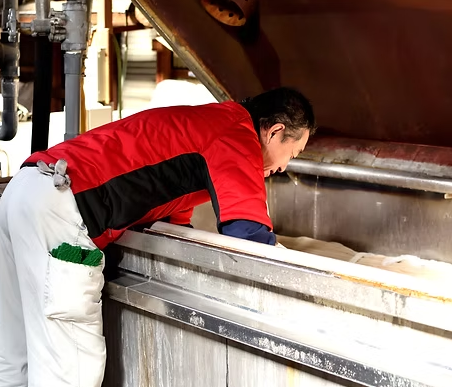
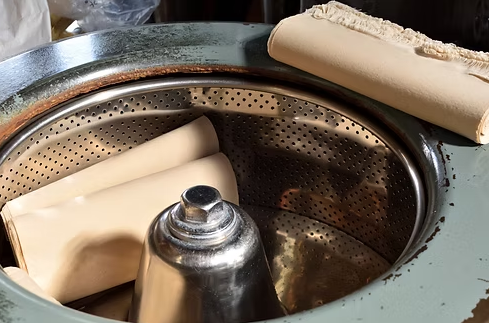
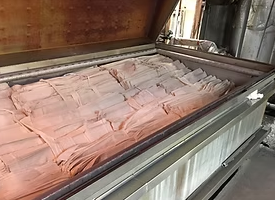
Fabric arriving from weaving mills is loaded into our 6,000-liter kettle and slowly boiled and refined over roughly four days. Soaking the cloth in water causes the yarn to stretch and shrink significantly — the finished fabric shrinks by about 10%. Because temperature, humidity, and water quality vary each time, a craftsman's eye and years of experience are indispensable.
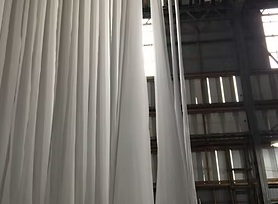
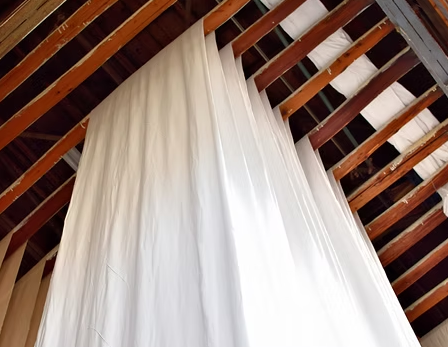
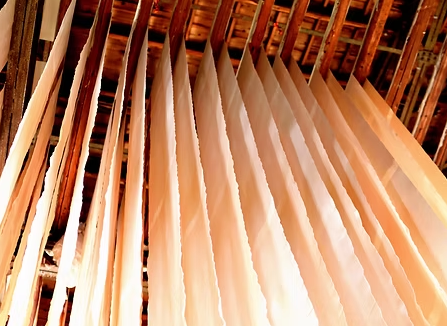
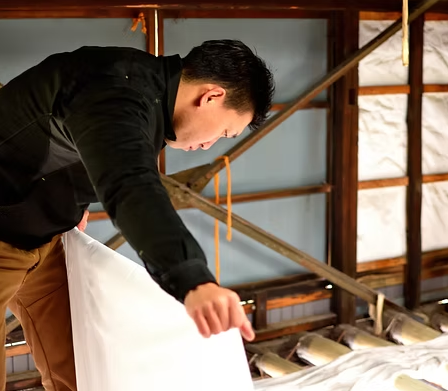
We never use machine dryers. Making use of 8-meter-high indoor pillars, we finish every piece with natural wind and sunlight alone, using our own tension-free hanging method. This is one reason our finish stands apart from other manufacturers.
We also handle bleaching for both wide and narrow gauze fabric, serving needs from medical and hygiene use to baby garments and bedding. The gentle touch and safety unique to wa-zarashi make it a trusted choice for even the most delicate applications.
Never leave it to machines. Never rush the process. Let nature do its part.
This has always been Hirano Sarashi's unchanging approach.
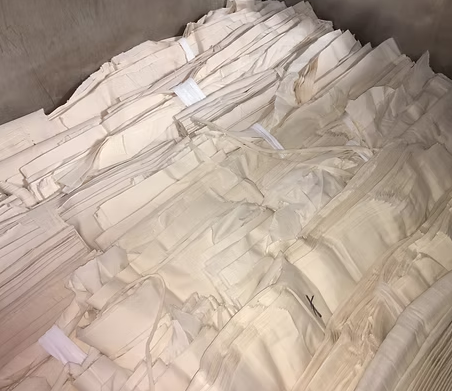
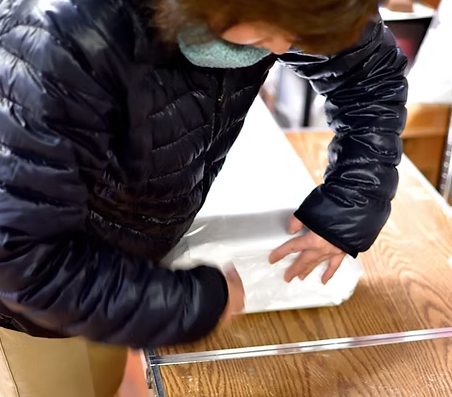
We inspect cotton fabric as it arrives from weaving mills, assessing its type and condition to prepare it for the process ahead. Every single bolt is handled carefully by our craftsmen.
The fabric is loaded into our 6,000-liter kettle and processed for roughly four days using traditional methods combined with specialized agents. Since that day's temperature, humidity, and water quality all affect the result, we never take our eyes off it.
Without any machine dryers, we finish each piece by sun-drying it on our 8-meter pillars. Our tension-free hanging method produces the fabric's distinctively soft texture.
Founded as a cotton-bleaching business in Fukutoku-cho, Kita-ku, Nagoya, Aichi Prefecture.
Preserving the kettle-boiling method passed down from the Edo period, we began supporting the local textile industry.
A large sun-drying yard with 8-meter-high pillars was completed.
This established our system of gentle, machine-free sun-drying.
Marking 90 years since founding, 3rd-generation Shigemi Hirano became Representative Director.
Under the banner "Traditional Wa-Zarashi to the World," we strengthened outreach both in Japan and abroad.
Our approach to wa-zarashi was featured in the Senken Shimbun trade newspaper.
This became an opportunity to spread awareness of wa-zarashi's value more widely.
From a small factory of four employees, we continue delivering genuine wa-zarashi to customers in Japan and abroad.
We are working on training successors and developing new markets to carry the wa-zarashi tradition forward.
| Company Name | Hirano Sarashi Co., Ltd. |
|---|---|
| Representative | Representative Director Shigemi Hirano |
| Founded | 1927 (Showa 2) |
| Business | Cotton bleaching (wa-zarashi bleaching, desizing, sun-drying, gauze processing) |
| Capital | ¥3,000,000 |
| Employees | 4 |
| Revenue | Approx. ¥20,000,000 (FY2020) |
| Address |
7-100 Fukutoku-cho, Kita-ku, Nagoya, Aichi 462-0052, Japan |
| Phone | +81-52-981-3649 |
| FAX | +81-52-913-0936 |
| nagoya.sarashi@gmail.com |
Feel free to reach out for sample requests, quotes, wholesale inquiries, or anything else. We typically reply within 2–3 business days.